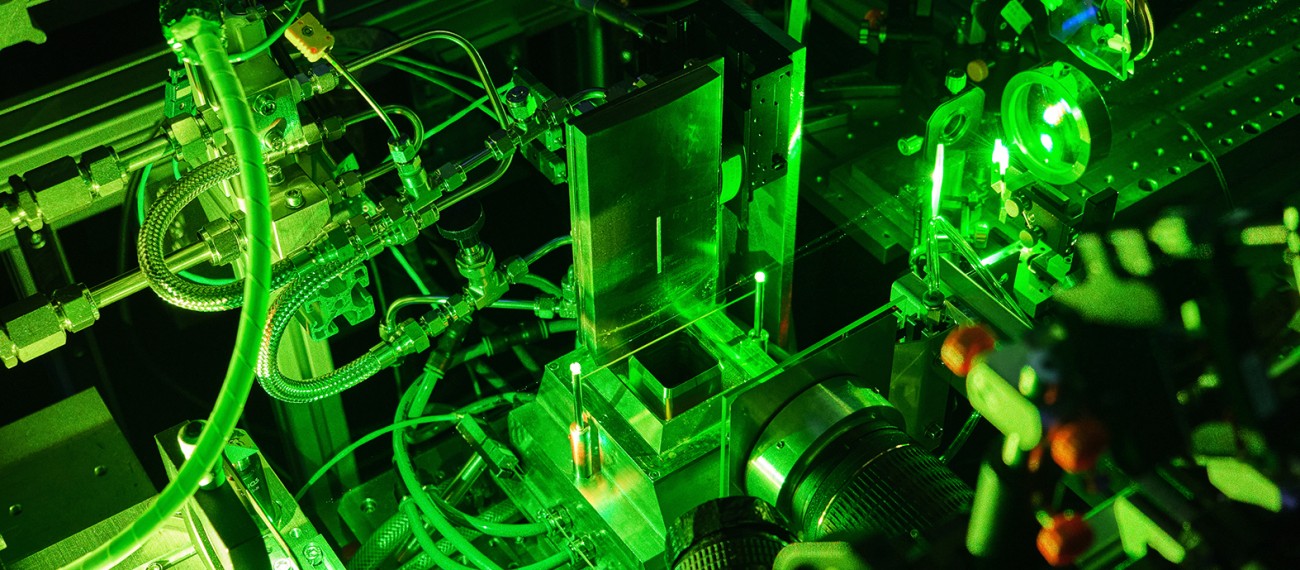
Laser-Induced Fluorescence (LIF) on the Optical Combustion Engine burning Hydrogen
Masterthesis
Motivation and Background
Using green hydrogen in an internal combustion engine holds the potential to mitigate all hydrocarbon emissions but is still plagued by NOx formation. Several strategies against NOx formation are available for spark-ignited engines (ultra-lean burning, dilution, etc) and is currently investigated by RSM.
The main interest lies in understanding how premixed, port fuel injection or direct injection affects air-fuel mixing and flame propagation. The experiments will be conducted in the RSM engine, which is optically-accessible from the piston, as well as from the liner. This enables the use of advanced laser diagnostics, such as tracer-LIF. As hydrogen and the air ambient are very inefficiently fluorescent, tracer (i.e., acetone, anisole, toluene, SO2) is evaporated into the air or fuel stream. Additionally, a simplified co-flow test bench is used to perform individual hydrogen injections that mix in a controlled atmosphere.
Earlier experiments have shown that similar fuel concentration results to Rayleigh scattering are possible with tracer-LIF. In addition, high-speed imaging of LIF has been successfully performed in the RSM optical engine in the past.
Tasks
- Setting up laser diagnostics and cameras
- Experimental plan
- Performing measurements
- Post-processing using Davis and Matlab/Python
- Result analysis
- Report writing